
How do I decide which design to move forward with?
It's all within stakeholder's feedback
Which stakeholder to ask can be based on the project, the specific feature, the stage of the project I am at, and normally in Wonderflow I base my design decision around these people:
• Developers for technical questions/constraints
• Business intelligence for business validation
• PM for clients’ expectations and user feedback (when pm is the direct user
for that feature)
• Fellow designers for design critique
• Design lead for the direction
The sections below are structured around the different stakeholders I need to communicated with, and for each stakeholder, I provide a few project-related examples to add more context.
Example 1
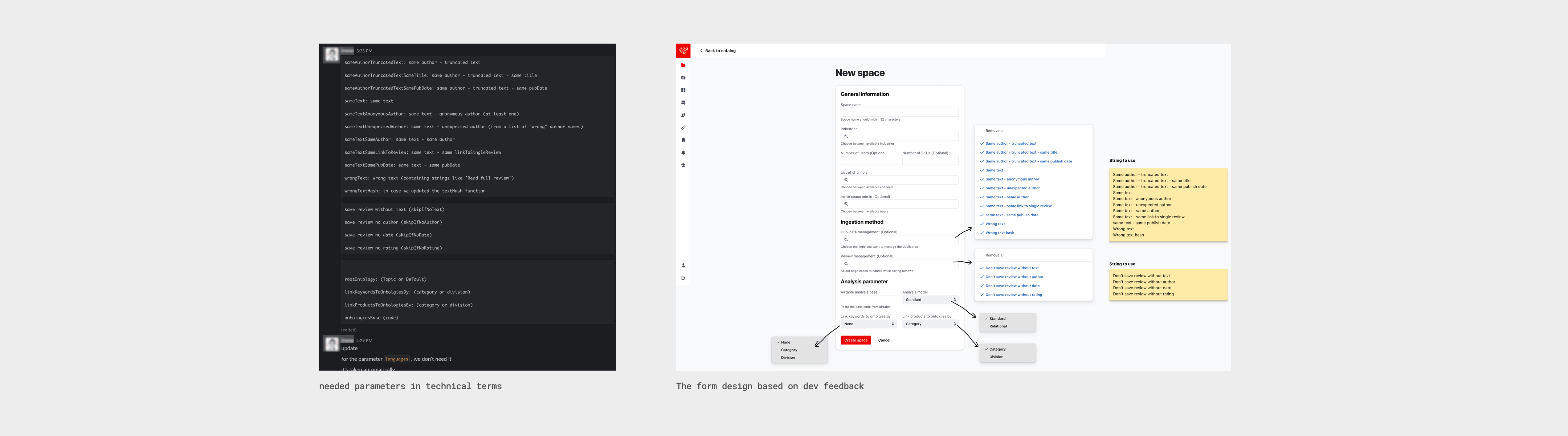
For project configuration project, developer knows best what parameters are needed in the form for PM to set up a project. In this case, their information and feedback have a direct impact on the design. To be specific, I designed the form structure based on the number of parameters we needed to include, and the technical terms they provided.
After getting right what parameters I need to include, I will start to consider the following: how many items to put in a row, how to group items together, which component to use (should I choose input field or single select or multi-select), what functionalities we need for the dropdown, advanced or basic? Do they need a search feature in the dropdown, do they need to select all & remove all functions, and how would the form look most clean, visually balanced and not cluttered? After solving the look and feel, I will go change the UI copy, I will rephrase the technical terms and check with PMs to see if the copy is clear, as they are the final user of this feature.
For this form design, I will need to communicate with both parties (Developer and PMs).
Example 2
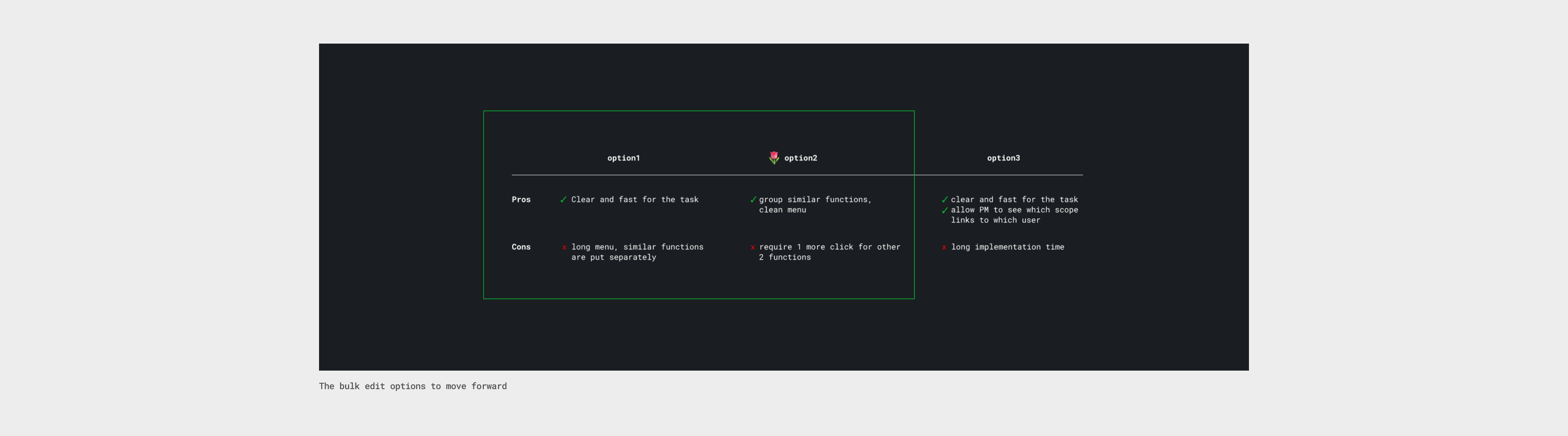
For the bulk edit user feature (from the user management project). At the final design stage, I left with 3 design solutions to consult people to get the project moving forward. Developers are my first go-to ask, as I already have a sense that these 3 options are quite different in terms of the implementation time.
After checking with developers these 3 options, I got a clear idea on the implementation time, and I got only 2 options left to check with PMs.
BI (business intelligence) team in our company is responsible for producing analysed reports for clients, they are the direct user of the dashboard. They are analytical and business-focused, and I often check with them whether a design makes business sense.
Example 1
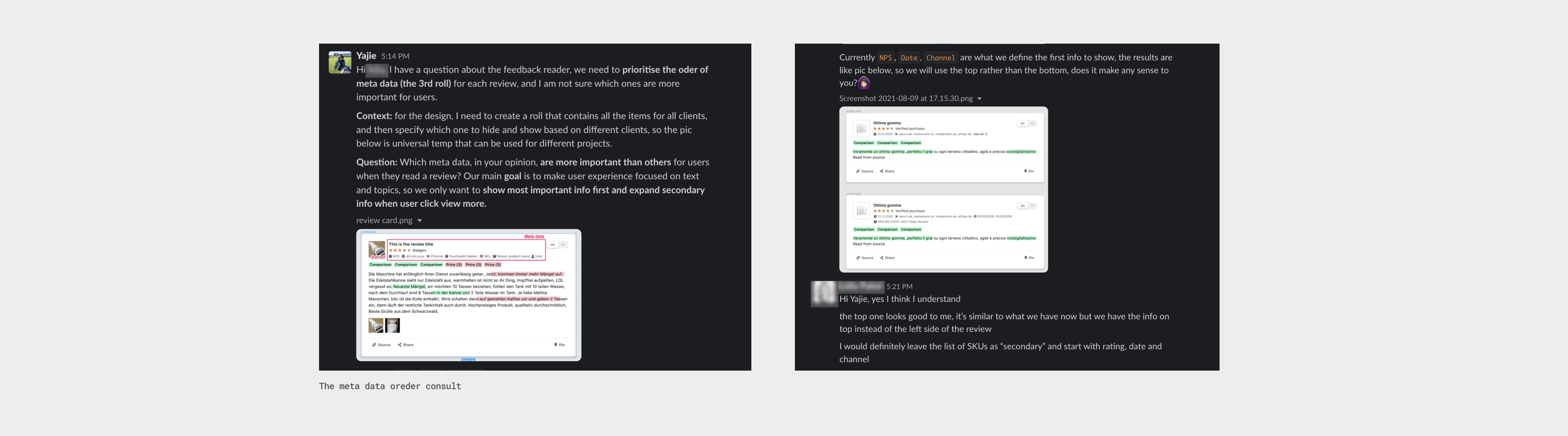
For feedback reader redesign project, we are changing the 2 column layout to horizontal ones to be responsive also on mobile. Since the layout has completely changed, I need to reorder the metadata linked with the review, and here I am asking in which order I put, will the metadata make most sense to our clients when they reading an analysed review. After checking with BI, I changed the order and move the design forward.
Example 2
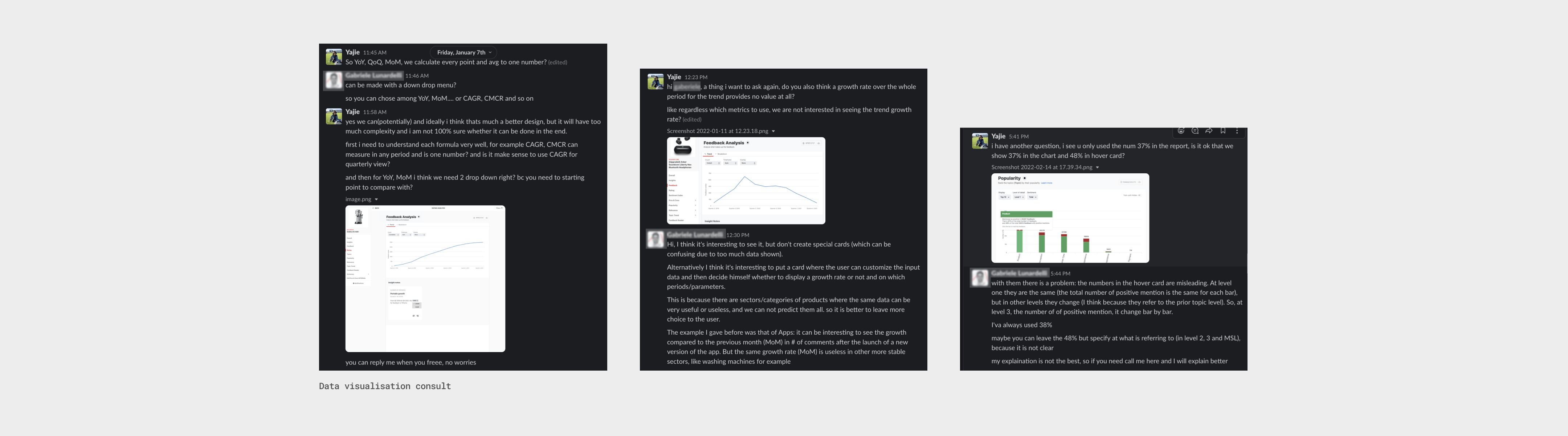
Data visualisation is another area I normally seek for BI's support for.
Same information, with different graphic representation(bar, line, pie, heat map etc), end up communicate and delivers different meaning. As a Saas product that specialised in data visualisation, is important to always get it right and remain our professionals brand image. So, whenever the project involves data visualisation part, I always make sure I check the design with the BI team.
In wonderflow, we are serving different clients, normally, I am not talking directly with clients, and the requirement of the clients often comes from PM, and I adjust my designs around PM's feedback.
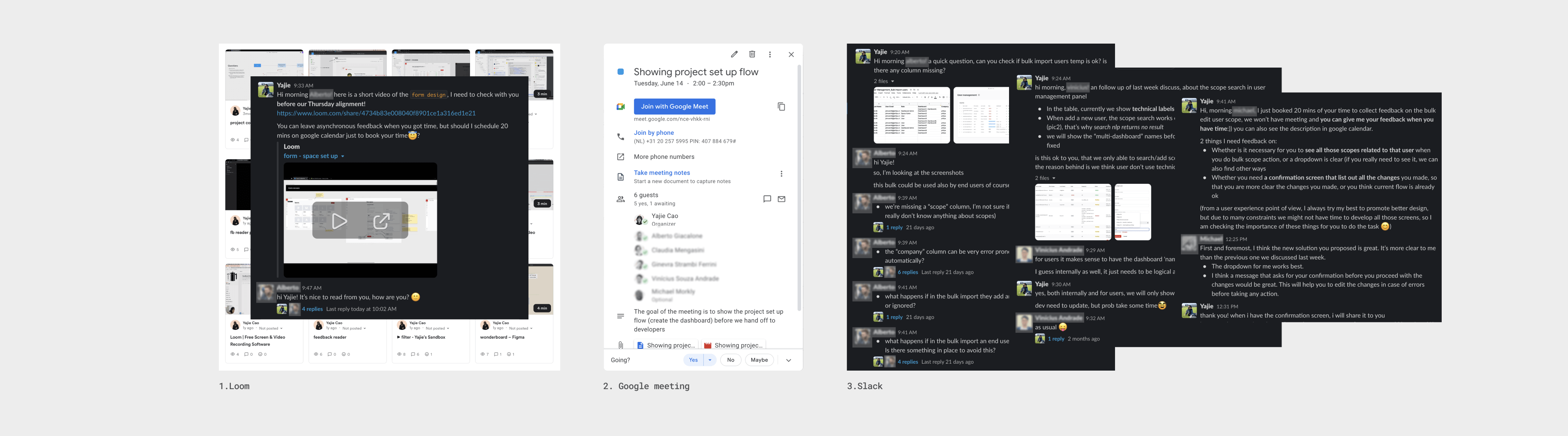
We have 10+ PMs that are responsible for different clients/brands, for each clients, the needs are bit different. If the feature is only for one particular client, I will only ask that PM; If it's a feature that needed for all clients, I will check with all PMs to make sure the solution I am designing works for them, and when is needed, add customisation for some specific use case.To get feedback from PMs, I usually communicate in the following ways:
1. Record a Loom to collect asynchronous feedback
2. Have a google meeting to talk in depth about one design
3. Or ask directly on slack
Example 1
For small design, I use slack for a simple vote, as is fast and easy.

Example 2
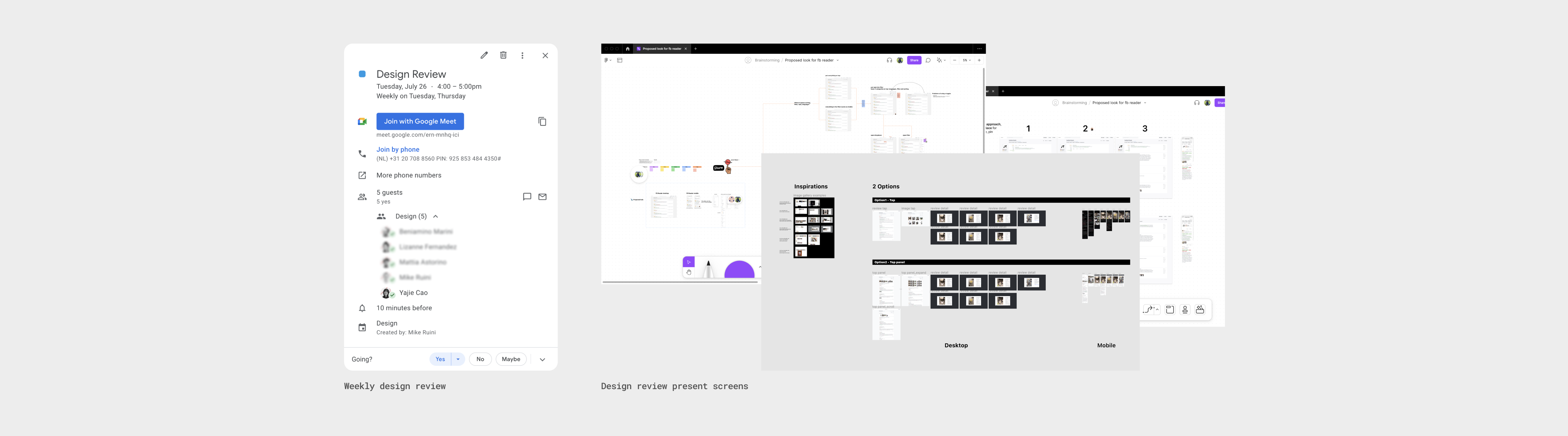
For designs that need more explanation, I usually book a slot in our weekly design review meetings, which happen twice a week. When I present, I will provide context to other designers about what I am working on, the problem I am solving, at what stage in the project I am, and whether there are any constraints and key timeline that they should be aware of. I won't cover all these points for all the reviews but only the ones that will influence their decisions, and the idea is about to begin the review with everybody on the same page. Then I will go on and showing different explorations, the pros and cons for each one, and my preferred solutions. I learned and improved my present skills from Femke channel! So shut out to her.
Example 3
Sometimes if I find one particular designer's opinion is more valuable for the project I am working on, I will only schedule a 1-on-1 meeting with he/she to talk in depth about one design.

Of course, things aren't perfect and not always work towards the perfect direction, trade-offs just part of being a designer, and I often have to let go of the ideas that I initially really liked or thought will be the best solution and go for the one that fit best for the situation.
At Wonderflow, sometimes we have to change the design because we are on a tight schedule to deliver a certain feature, sometimes might also change based on design lead's preferences. Design is biased by its nature, as is ultimately, a human decision, we can only try to make it more objective. My boss is amazing, he created the Wonderboard, and he has his own believes, it might not always be right, but I always respect his idea, yet try my best to show alternatives when I think his solution is not the best fit. I won't always succeed, sometimes it just because I am wrong, and I don't see the big picture as my lead see; other times is might because I am not that good at articulating my thoughts and not have that strong conviction with my design, yet.
But is all good, I believe experience and confidence will come with time, as I grow :).
