Year
May 2021 – Now
Role
Product design
Tools we use
Figma, Slack, Trello, Confluence, Airtable, Metroretro, Google Docs, Loom, Adobe suite
What my day-to-day looks like?
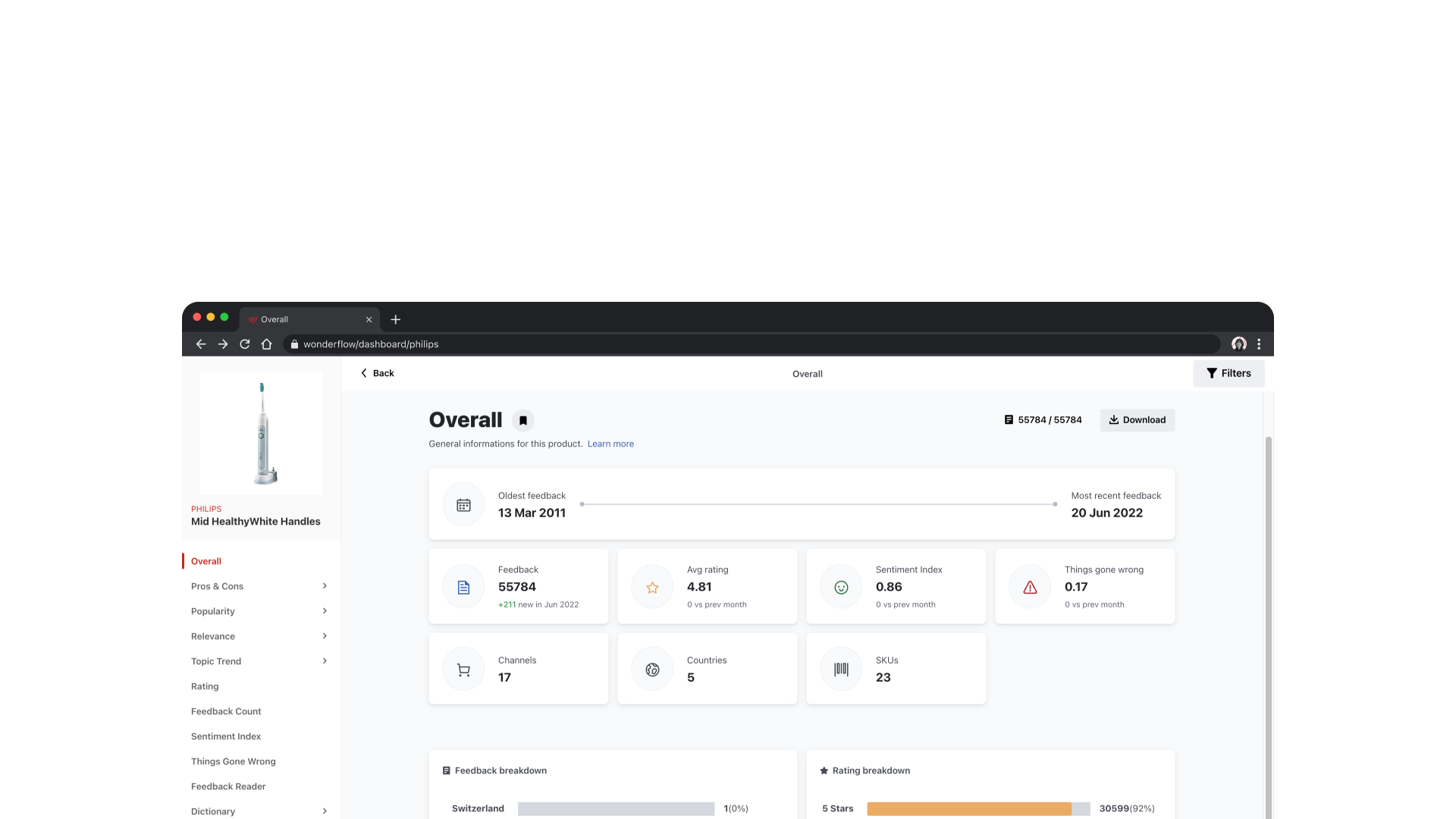
I work mainly on the product, Wonderboard - a natural language processing based dashboard that analyze customer & product reviews.
My daily work consists of communicating, designing and validating different product features, working with existing design systems, and navigating between cross-functional teams.
Design process
01 Get user stories
02 Rewrite brief & Link tasks on Trello
03 Brainstorming & Designing & Iterating
04 Stakeholder alignment
05 Prepare hand off file
06 Hand off meeting with dev
07 Quality check

In wonderflow, feature requirement comes in different ways: it could come directly from clients (contract-based & improvement needed), or internal stakeholders (company roadmap, design lead, BIs, PMs etc).
The design lead then collects and defines the features that need to be developed, passes the requirements to me (via Airtable - we use Airtable to document features). If clarification is needed, meetings or slack huddles can be scheduled.

Once I got my task, I will spend some time to do the planning work:
• Rewrite the design brief and user stories in a way that works most efficient for me;
• Link my project and task on trello board;
• Identify the people i need involved for this feature to collect additional information from.
• Work with po, design and data team to define success metrics (still lacking)
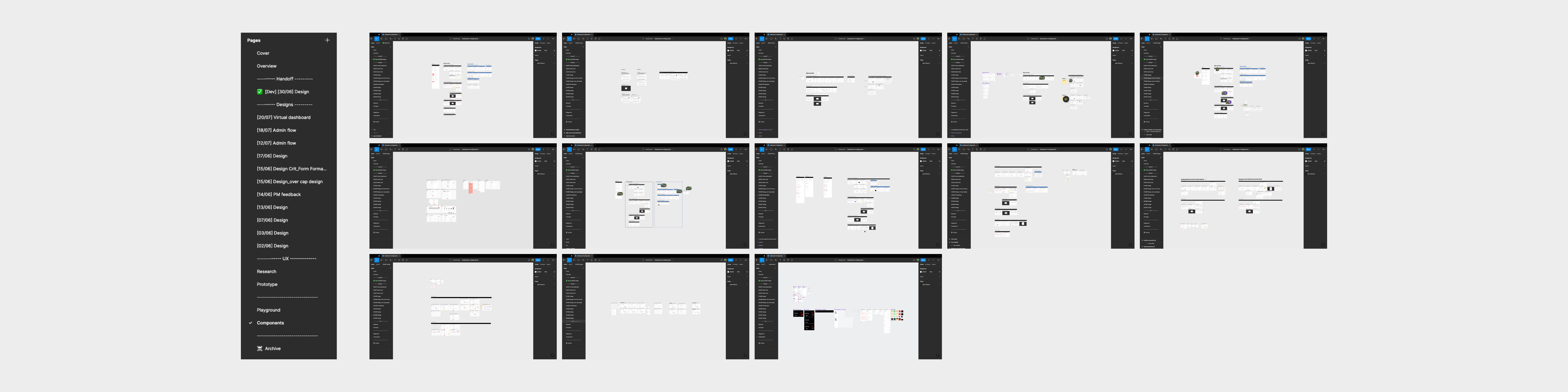
The design starts with me exploring different design options, looking for good practices online, gathering feedback from relevant stakeholders/other designers, and continuous iterating.
However, design is not a linear process, it’s filled with meetings and alignment with different stakeholders throughout, and the requirement can change on the go, requiring me to constantly adapt to new ones. Often times, you need to make trade-offs based on time constraints, technical constraints, and sometimes, personal taste. And the edge cases are always there, sometimes it might be a screen is missing, and we are only able to spot once the design has been implemented.

I always validate my designs with relevant stakeholders (designers for look and feel, PM for client requirements, BI for business expectations), but when the project gets too big, this can become an issue, we end up with too many alignment meetings. Additionally, people forget the things they've said in the past, and some topics have to be re-discussed, this is not a efficient way of working.
Spot this issue we have in our organzation, I take the initiave of taking meeting notes for the project i am working on. Having a meeting note can help everyone evolved in sync with what we’ve discussed in the meeting and trace back every decision we’ve made along the way.
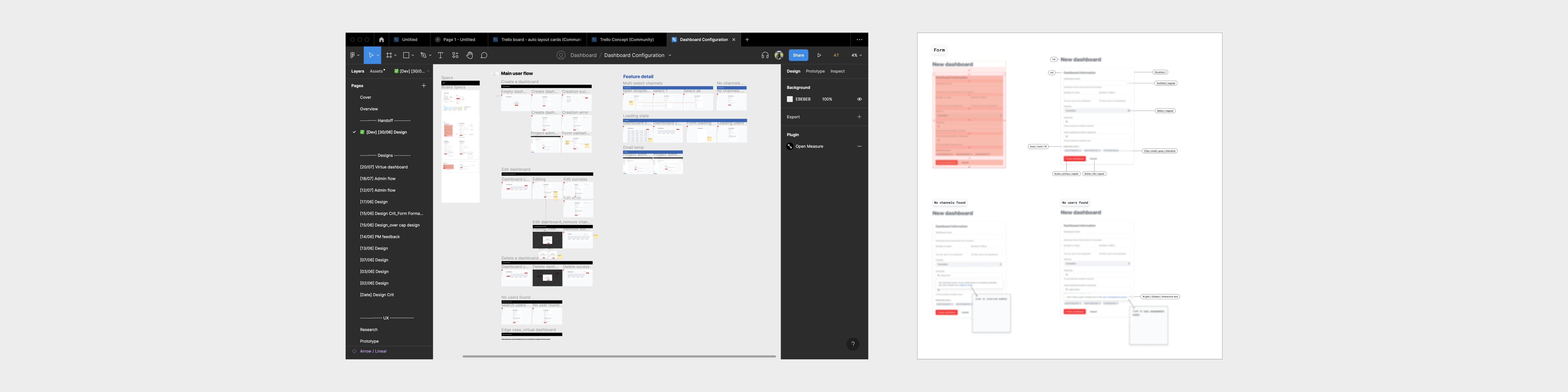
The hand off file normally contains the following parts:
• Measurement specs (Links to design system component)
• Component state (if needed)
• Main user flows
• Working prototype (if needed)
• Logic / data requirement (if needed)
• Event track link to Mixpanel
We try to reduce the inspect work dev needed to do in Figma, it’s time consuming at first, but it saves everybody’s time later on, as the implementation is less prone to error.

Before the implementation, we would have a hand off meeting with developer, i would walk through the whole flow and point out a few things that need extra care. It can be 5mins huddle or 30mins meeting depending on the project, it doesn’t matter, what matters is at the end of this meeting, we share the same expectation for the project.
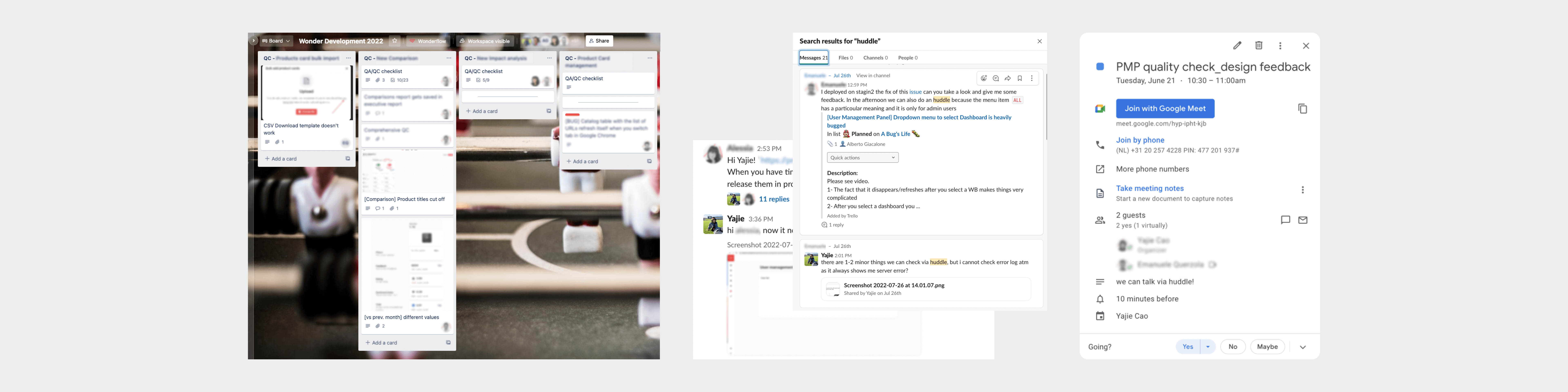
After the implementation & before we go live, we have 2 weeks quality check period to ensure the feature is solid. Different stakeholders are involved in the quality check process, issues are submitted and managed via Trello board.
From design part, the quality check is not one-off event that happens after everything is built, the process starts from the moment of implementation, and consists of multiple quick check points with devs.
